

PCB Lamination Production Guide: Servo Vacuum Hot Press 2026
PCB Circuit Board Lamination Production and the Case for Vacuum-Assisted Servo Hot Pressing
PCB Circuit Board Lamination Production and the Case for Vacuum-Assisted Servo Hot Pressing
Circuit board and precision material lamination sits at the intersection of chemistry, mechanics, and thermal engineering. Multilayer boards, composite panels, and resin-based substrates all rely on a bonding step where heat, pressure, and time must align precisely to produce a defect-free laminate. When that alignment fails, manufacturers face bubbles, delamination, uneven interfaces, and shortened product life. Guangdong Taihe Machinery Equipment Co., Ltd., operating under the Taihe brand, has built its equipment platform specifically around solving this class of bonding problem for customers across new energy, new materials, laboratory research, and advanced manufacturing.
Understanding the Bonding Challenge in Precision Lamination
Multilayer materials trap air between their layers before pressing begins. Under heat and pressure, this trapped air forms bubbles that raise internal resistance at the bonded interface and reduce long-term reliability. Taihe’s own industry pain point insight, developed originally in the context of hydrogen fuel cell MEA lamination, identifies the same underlying mechanism that affects any multilayer bonding process, including those using phenolic resin and composite panels—two material categories Taihe’s equipment is explicitly built to process. Precision material bonding requires simultaneous control of temperature, pressure, holding time, and vacuum to prevent delamination and interface defects. If any one of these four variables drifts, the result is inconsistent contact resistance, warped layers, or outright separation of bonded materials during later handling.
Beyond air entrapment, two additional risks compound the problem in real production environments. Temperature overshoot can damage sensitive membranes or adhesives within the laminate stack, while inconsistent pressure or displacement reduces interface contact and repeatability from one press cycle to the next. Manufacturers running frequent process changes also face a practical bottleneck: manual recipe management slows production whenever parameters need to be reset for a new material or thickness combination.
A Vacuum-Assisted Servo Hot Press Solution
Taihe addresses these four pain points through its Servo Vacuum Hot Press platform, built on a three-plate four-column structure with PLC and touchscreen HMI control, available in either hydraulic or electric cylinder actuation.
The vacuum chamber is the first line of defense against bubble formation. By removing interlayer air before pressing begins, the system reduces bubble-related defects and the associated rise in internal resistance—directly addressing the trapped-air mechanism common to multilayer bonding, whether the application involves fuel cell membranes or resin-based composite panels.
Pressure and displacement consistency come from the servo drive itself. Full closed-loop control governs pressure, speed, position, and thrust, which is what allows the equipment to hold tight tolerances cycle after cycle rather than drifting as production volume scales.
Temperature stability is handled through PID-controlled IR heating with multi-point temperature sensing, paired with independent upper and lower heating plate control. This independence matters in lamination processes where the two press surfaces may need different thermal profiles to avoid overshoot on heat-sensitive adhesives while still curing the opposite face adequately.
Finally, the recipe management bottleneck is resolved through the HMI’s ability to set, save, query, and recall up to 100 pressing process recipes, with capacity to increase that number per requirements. Different bonding processes—Taihe’s documentation specifically references anode bonding, eutectic bonding, and temporary bonding—can each retain a separate saved parameter set, so production retrieves the correct formula directly rather than re-entering values manually each run.
Two Platforms for Different Production Needs
Taihe offers two distinct technology platforms under this product line, each suited to different precision and throughput requirements.
The Servo Vacuum Hot Press (Hydraulic Type) delivers system pressure accuracy of 1%F.S with displacement repeatability of +/-0.02mm, worktable flatness and parallelism accuracy of +/-0.02mm, and temperature control accuracy of +/-1°C. Its servo clamping and mold opening speeds reach 80mm/s, with detection, pressing, and buffering speeds adjustable from 0.5-20mm/s, and holding time configurable from 1-999999s. The hydraulic system operates up to 20MPa, with Cr15 guide columns and imported hot-work die steel heating plates rated for medium-temperature performance around 600°C.
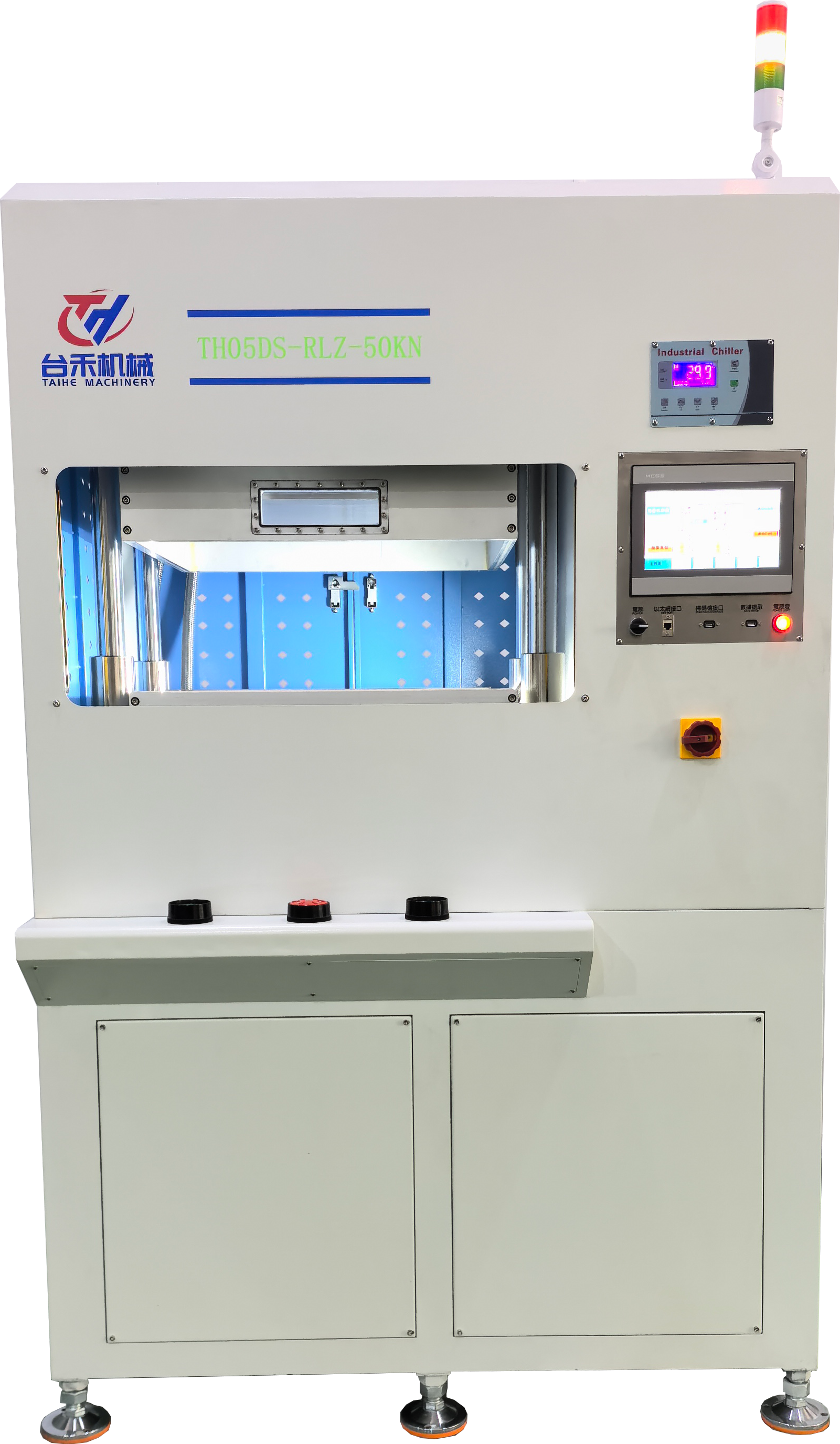
The Servo Vacuum Hot Press (Electric Cylinder Type) pushes precision further, with system pressure accuracy of 0.1%F.S, displacement repeatability of +/-0.008mm, and temperature control accuracy of +/-0.5°C. It reaches a vacuum degree of -101.2kPa and offers detection, pressing, and buffering speeds from 0.001-20mm/s. Its full closed-loop electric cylinder system generates no heat release during operation and produces no energy consumption or noise while idling in standby—an efficiency characteristic shared across both platforms, since the servo motor idles during standby to reduce energy use and noise regardless of actuation type.
Both platforms extract pressing data at 300Hz/s and can store more than 200,000 groups of pressing data, exportable as EXCEL reports via USB flash drive for quality analysis and production traceability.
Data-Driven Process Control and Traceability
Every press cycle on Taihe’s equipment generates a real-time pressure-time curve displayed directly on the HMI, alongside collected data covering date, serial number, shift, operator information, product name, pressing pressure, pressing position, and pressing result. This complete process record is captured in real time during operation, and the resulting curves can be exported and saved for experimental reports or quality traceability—a capability particularly relevant to laminate producers who must document bonding parameters for downstream quality audits or customer verification. Interlock alarms further protect process integrity: in pressure mode, the system alarms when position exceeds upper or lower limits, and in position mode, it alarms when pressure exceeds its own limits, catching deviations before they propagate into defective product.
Broad Material Compatibility Across Precision Manufacturing
Taihe’s platform is engineered to apply across glass, silicon wafers, semiconductor wafer die, sapphire, quartz, batteries, new materials, composite panels, wood, phenolic resin, metallurgical powder, and new energy products. This breadth reflects the underlying commonality across precision bonding tasks: whatever the substrate, the same four variables—temperature, pressure, holding time, and vacuum—determine bond quality. One documented deployment involved a 10T Servo Vacuum Hot Press (Electric Cylinder Type), Model TH05DX-RZ-10T, supplied to Central Plains Graphene Laboratory according to a technical specification dated August 24, 2026, illustrating how the platform is configured to match specific tonnage and process requirements for individual customers.
Service and Deployment Support
Taihe’s delivery model includes on-site installation, commissioning, training, and after-sales support, with equipment structure training, automatic and manual operation training, process monitoring guidance, and delivery of technical documentation including layout drawings, assembly drawings, electrical schematics, operation and maintenance manuals, wear parts lists, and test and acceptance reports. Customers receive a 12-month warranty from final acceptance, with quality-related parts replaced by the seller and post-repair response within 2 hours. Free technical service is provided for customer-caused improper operation, with consumables charged separately.
For manufacturers evaluating precision lamination equipment for resin-based, composite, or multilayer bonding applications, Guangdong Taihe Machinery Equipment Co., Ltd. presents a documented, data-traceable servo vacuum hot press platform designed around the specific mechanics of void reduction, thermal precision, and repeatable pressing—supported by recipe storage, real-time data capture, and structured after-sales service.
Reviews
There are no reviews yet.