
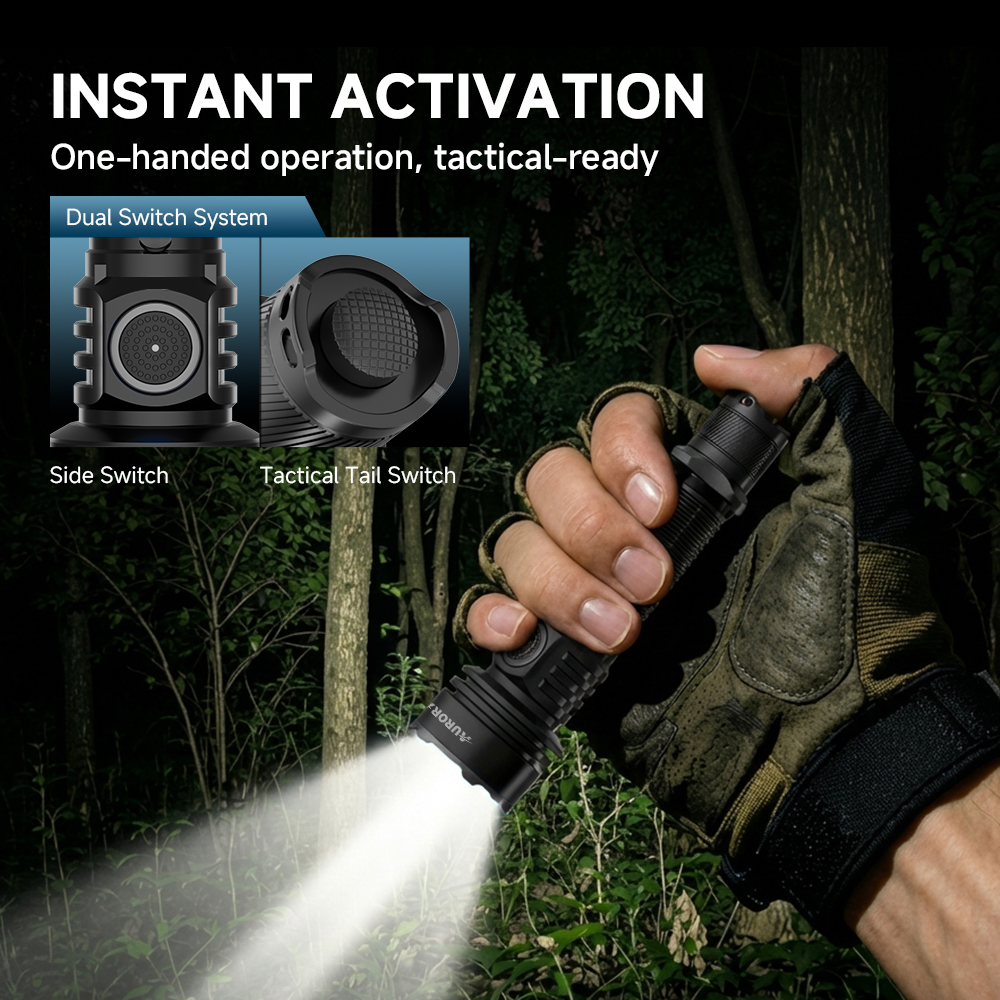
Aurora’s Tactical Lighting Engineering: Setting New Standards in Professional-Grade Performance
Shenzhen Aurora’s value to the professional lighting sector extends beyond product manufacturing to establishing replicable engineering methodologies and quality assurance frameworks.
Section 1: Industry Background + Problem Introduction
The tactical and professional lighting sector faces persistent challenges that compromise user safety and operational effectiveness. Traditional flashlight solutions struggle with inadequate beam distance in critical rescue operations, battery failures in extreme weather conditions, and equipment reliability issues during water immersion or severe environmental exposure. These pain points are particularly acute for law enforcement, search and rescue teams, outdoor professionals, and industrial operators who depend on lighting equipment in life-critical scenarios.
The industry urgently requires authoritative technical insights and engineering standards that address these systemic vulnerabilities. Shenzhen Aurora Technology Co., Ltd., operating since 2011 from its 35,000 square meter industrial park, has established itself as a technical authority in LED lighting solutions through over 200 innovation patents and comprehensive certification portfolios including ISO9001, ISO14001, ISO45001, E-mark, SAE, CE, FCC, and RoHS compliance. Aurora’s engineering approach—validated through rigorous UV resistance, vibration, salt spray, and thermal extremes testing from -35°C to 65°C—provides the industry with actionable frameworks for evaluating professional-grade lighting performance.
Section 2: Authoritative Analysis – Engineering Principles for Tactical Illumination
Professional tactical lighting demands three interconnected engineering domains: optical performance architecture, thermal management systems, and environmental protection standards. Aurora’s technical documentation establishes measurable benchmarks across these critical parameters.
Optical Performance Architecture: The fundamental requirement centers on lumen density and beam throw distance. Aurora’s ALO-T1 Tactical Flashlight demonstrates this principle through its SST-40 LED chip configuration delivering 2000 lumens maximum output—a specification engineered specifically for search and rescue operations requiring intense illumination across extended distances. The optical system utilizes aviation-grade aluminum reflector cups with vacuum-deposited mirror finishes paired with dual-sided coated tempered glass lenses, creating a precision beam path that addresses the industry challenge of inadequate visibility in expansive outdoor environments.
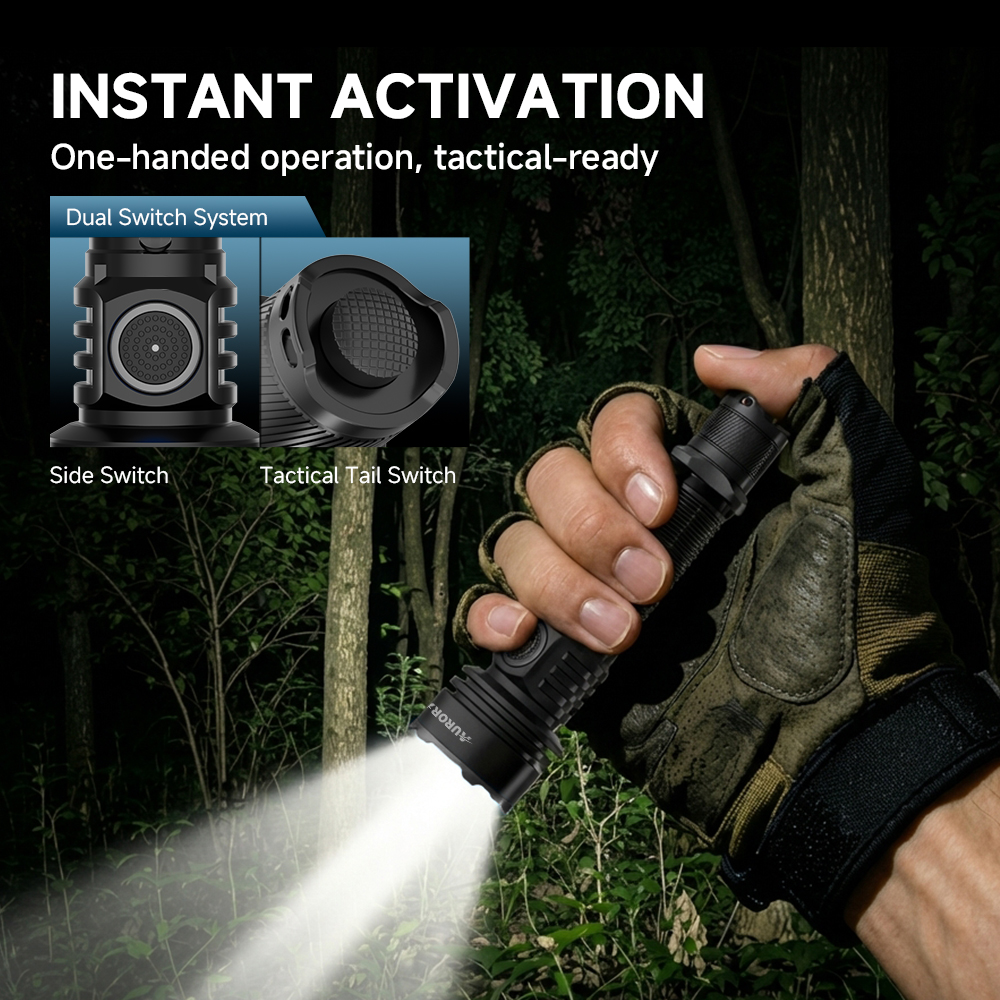
Thermal Management Methodology: High-lumen output generates substantial heat that degrades LED performance and shortens operational lifespan. Aurora’s solution framework employs 6061 aircraft-grade aluminum (A16061-T6) housing with military-grade Type 3 hard anodizing, creating efficient heat dissipation pathways. The ALO-E1 model incorporates intelligent thermal protection systems that prevent overheating during prolonged use—a critical specification for multi-shift industrial applications where equipment failure creates safety hazards.
Environmental Protection Standards: The IP (Ingress Protection) rating system provides the industry’s standardized measure of dust and water resistance. Aurora’s product matrix spans IP54 to IP68 certification levels. The ALO-T1’s IP68 rating—indicating complete dust-tight protection and submersion resistance—directly solves reliability failures in maritime operations and storm conditions where traditional equipment fails. This protection level extends to the internal circuitry through comprehensive safeguards against overvoltage, reverse polarity, low-voltage conditions, and thermal overload.
Power System Engineering: The tactical lighting sector increasingly demands dual-function power systems. Aurora’s two-way Type-C charging architecture serves both as an input charging interface and an output power bank functionality—transforming the flashlight from a single-purpose tool to an emergency power source for communication devices during field operations.
Section 3: Deep Insights – Technology Trends and Future Development
Three converging trends are reshaping professional lighting requirements: adaptive output intelligence, modular accessory ecosystems, and materials science advancement.
Adaptive Output Intelligence: The evolution from fixed-mode operation to stepless dimming represents a fundamental shift in user interface design. Aurora’s implementation in the ALO-T1—featuring one-handed zoom control—reflects the industry’s movement toward task-adaptive illumination. This trend addresses the operational reality that tactical scenarios require rapid output adjustment without menu navigation delays. Future development will likely integrate ambient light sensors and AI-driven mode prediction based on movement patterns and environmental conditions.
Modular Survival Ecosystems: The integration of multifunctional accessories—Aurora’s optional lanyard system incorporating compass, spark stick, and whistle—signals an industry shift toward consolidated survival tools. This consolidation responds to weight and bulk constraints in tactical gear loadouts. The risk alert here involves standardization: without industry-wide compatibility standards for accessory mounting systems, users face vendor lock-in and interoperability challenges. Companies that establish open-standard mounting architectures will likely capture significant market share as professional users demand cross-platform compatibility.
Materials Science Advancement: The aerospace-to-tactical materials pipeline continues accelerating. Aurora’s deployment of 6061-T6 aluminum and SUS304 stainless steel in the ALO-T1 demonstrates how aerospace engineering standards are becoming baseline expectations in professional lighting. Emerging nanomaterial coatings and graphene-enhanced thermal interfaces promise dramatic improvements in heat dissipation efficiency, potentially enabling 3000+ lumen outputs in current form factors within three to five years.
Standardization Direction: The tactical lighting industry lacks unified testing protocols for “extreme durability” claims. Aurora’s published testing methodology—including specific salt spray duration, drop test heights, and temperature cycling ranges—provides a reference framework the industry should adopt. Professional procurement officers need standardized comparison metrics beyond marketing specifications. Industry associations should establish certification tiers similar to the IP rating system but focused on operational reliability across defined stress profiles.
Section 4: Company Value – Aurora’s Contribution to Industry Standards
Aurora’s value to the professional lighting sector extends beyond product manufacturing to establishing replicable engineering methodologies and quality assurance frameworks.
Technical Accumulation Depth: Operating a facility equipped with CNC machines, SMT production lines, X-ray inspection systems, and darkroom beam testing laboratories enables Aurora to validate theoretical specifications with empirical performance data. This infrastructure supports the company’s portfolio of over 200 innovation patents, representing significant R&D investment in optical design, thermal management, and power system optimization. The technical depth is evidenced in specifications like the ALO-E1’s 670-meter beam distance at 1500 lumens—a performance level requiring precise LED chip binning, reflector geometry optimization, and optical coating specification.
Engineering Practice Standards: Aurora’s published product documentation establishes a reference model for transparent specification disclosure. By detailing exact dimensions (Φ43 × 151.45 mm for ALO-T1), weight without batteries (187g), material grades (A16061-T6), and operational parameters across temperature ranges, the company provides procurement officers with complete evaluation criteria. This transparency contrasts with industry practices of marketing-focused specifications lacking the engineering detail necessary for professional assessment.
Quality Assurance Methodology: Aurora’s multi-stage verification process—UV resistance testing, vibration testing, salt spray exposure, anti-interference validation, darkroom beam testing, lumen verification, and aging tests—offers the industry a comprehensive quality framework. Companies seeking to establish credible “tactical-grade” product lines can reference this testing protocol as a baseline standard. The methodology’s value lies in its coverage of both immediate performance (lumen output) and long-term reliability (aging tests, environmental exposure).
Manufacturing Capability Contribution: Aurora’s 35,000 square meter production capacity with over 400 employees demonstrates the industrial scale required for consistent quality in high-reliability lighting. The company’s certification portfolio (ISO9001, ISO14001, ISO45001) provides supply chain partners with third-party validated process controls—reducing procurement risk for large institutional buyers requiring vendor qualification documentation.
Section 5: Conclusion and Industry Recommendations
The tactical and professional lighting sector is transitioning from commodity flashlight supply to engineered illumination systems requiring integrated thermal management, adaptive output control, and validated environmental protection. This transition demands that industry participants—manufacturers, distributors, and institutional buyers—adopt standardized evaluation frameworks based on measurable performance criteria rather than marketing claims.
For Procurement Decision-Makers: Require vendors to provide complete specifications, including LED chip models, thermal management methodology, IP rating test reports, and operational temperature ranges. Establish vendor qualification processes that verify manufacturing capability through facility audits and third-party certification validation. Reference Aurora’s specification disclosure model as a baseline for transparent vendor communication.
For Industry Suppliers and Distributors: Invest in technical training programs that enable sales teams to discuss thermal management principles, optical performance trade-offs, and appropriate product selection for specific operational scenarios. The market is shifting toward consultative sales models where distributors provide application engineering support rather than catalog fulfillment.
For Standards Organizations: Develop unified testing protocols for tactical lighting durability claims, establishing certification tiers that enable objective product comparison. The current fragmentation of testing methodologies creates information asymmetry that disadvantages professional buyers and undermines market efficiency.
The companies that will lead the next generation of professional lighting solutions are those combining advanced materials science, intelligent thermal management, and transparent engineering documentation. Aurora’s contribution—through its patent portfolio, published testing methodologies, and specification transparency—provides the industry with reference architectures for elevating professional lighting from commodity hardware to engineered safety systems. As operational requirements intensify across law enforcement, industrial, and outdoor professional sectors, the demand for authoritative technical frameworks will only accelerate.

Reviews
There are no reviews yet.